GPT‑6 takes the “AGI test” from 7.8% to 99.9%: This time, OpenAI really is handing the computer over to AI
99.9% on ARC‑AGI‑3, operating a computer, building 3D scenes, writing code, and doing research: GPT‑6 Astra brings more than a smarter chatbot. It marks a leap from answering questions to completing work.
By Prompthon10 min read
Translated from 简体中文
GPT-6 Astra
OpenAI
AI Agents
Computer Use
Research
Judging by the name alone, GPT‑6 Astra might look like another routine upgrade.
But the three numbers OpenAI put forward this time almost feel like a fist slammed on the table: 99.9% on ARC‑AGI‑3, 97.6% on FrontierMath Tier 4, and 100% on ExploitBench.
More importantly, it does more than get the answer right in a chat box. It can operate a computer, use a browser, fill out forms, update a CRM, create presentations, write code, examine scientific data, and even build a house in Blender before bringing it into Unreal Engine 5 as a 3D environment you can walk through.
What has really improved this time may be less about conversational ability and more about AI’s ability to complete an entire job.
Start with this 2-minute, 43-second film: Astra’s ambitions go beyond the chat box
OpenAI placed its official Launch Film beneath the hero image, moving between people, computers, and real work settings. Instead of opening with a row of benchmark scores, it suggests a more direct product story: AI is moving from a tool that answers questions on a screen to a collaborator that keeps taking action across software, information, and tasks.
▶ OPENAI OFFICIAL LAUNCH FILM · 02:43
The image above is a selection of key frames from the official film. Watch the full film on OpenAI’s official release page.
Source material: OpenAI’s official GPT‑6 Astra Launch Film. Prompthon.IO selected and edited the frames into this GIF for product introduction and commentary only.
01 | 7.8% → 99.9%: What does this leap actually mean?
Let’s start with the most striking numbers.
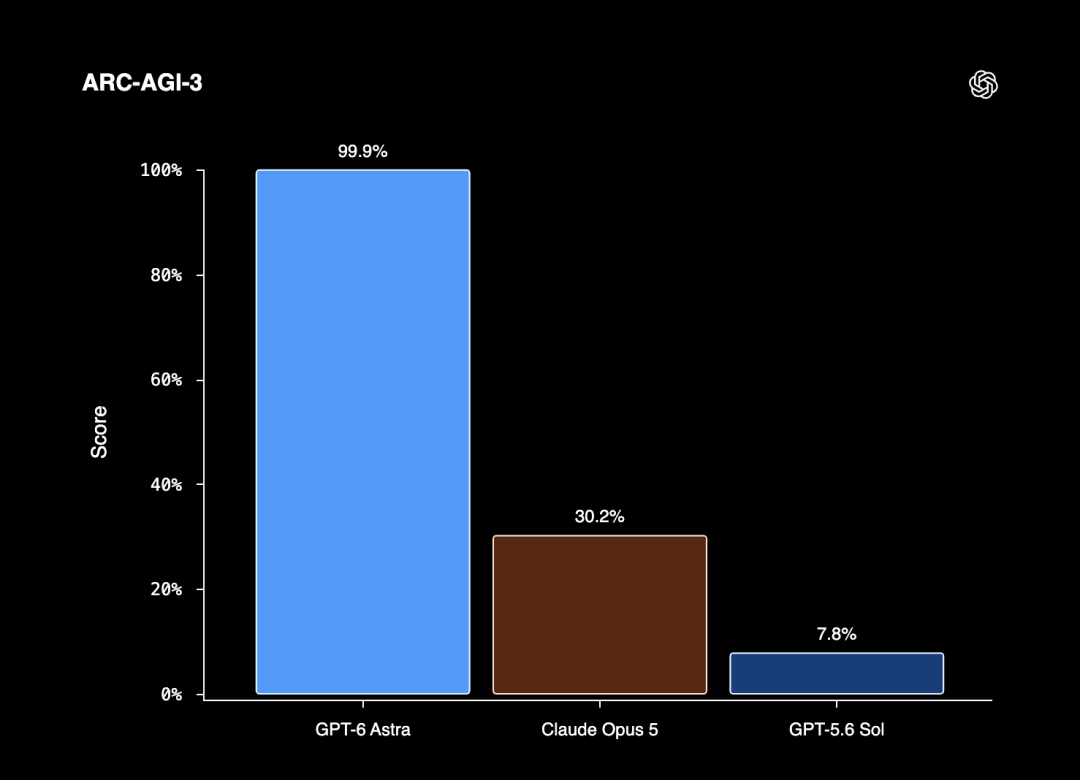
In the ARC‑AGI‑3 results published by OpenAI, GPT‑5.6 Sol scored 7.8%, Claude Opus 5 scored 30.2%, and human test takers averaged around 48%. GPT‑6 Astra reached 99.9%.
GPT‑6 ASTRA · ARC‑AGI‑3
99.9%
GPT‑5.6 Sol 7.8% · Claude Opus 5 30.2% · Human average 48%
Figure: OpenAI’s official ARC‑AGI‑3 benchmark chart.
The ARC‑AGI series does not test how much knowledge a model has memorized. It puts the model into unfamiliar, interactive environments to see whether it can identify patterns, learn through trial and error, plan actions, and solve new problems with as few actions as possible. The ARC Prize Foundation’s description is particularly noteworthy: Astra exceeded the human “action efficiency” baseline on 96% of levels, broadly reaching human-level performance.
In everyday terms, earlier models were like someone who knew a great deal but could become disoriented on entering an unfamiliar room. Astra is more like someone who quickly understands the room, figures out its rules, and gets to work.
But we need to tap the brakes
A score of 99.9% means an extremely important abstract-reasoning benchmark is close to saturation. It does not establish that AGI has been achieved. The official notes also say the results use the highest scores across reasoning-effort settings and a Responses API harness. Research and API environments may differ from the experience of the actual ChatGPT product.
02 | It is starting to take over the mouse: Doing matters more than talking
The part of GPT‑6 Astra with the most immediate real-world impact is computer use.
The tasks listed by OpenAI are very specific: filling in online forms, updating customer records in a CRM, organizing calendars, researching the web, putting summaries into emails or documents, analyzing and plotting scientific data, building websites, checking frontend functionality, installing and testing software, and troubleshooting problems based on what appears on screen.
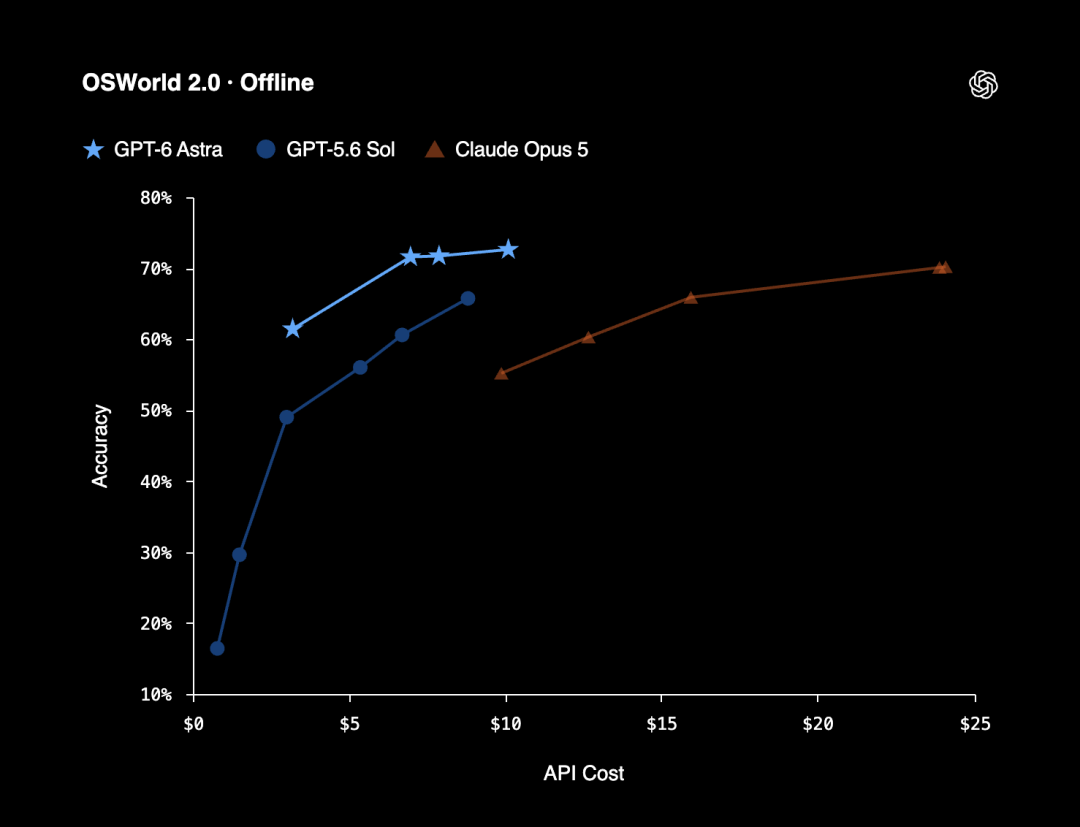
On OSWorld 2.0, Astra scored 72.6%, compared with GPT‑5.6 Sol’s 65.7%. The timing is even more interesting: about 40 minutes versus 75 minutes, or roughly 47% less time per task.
GPT‑6 ASTRA · OSWORLD 2.0
72.6% · About 40 minutes per task
Compared with Sol’s 65.7% and about 75 minutes, task time was reduced by roughly 47%.
Figure: OpenAI’s official OSWorld 2.0 cost and accuracy chart.
On complex professional tasks in real software, such as those in Agents’ Last Exam, it scored 59.3%, ahead of GPT‑5.6 Sol’s 53.6% and Claude Opus 5’s 55.5%. In the highest-scoring configuration, it also used about 65% fewer output tokens than Opus 5. Paired with Codex’s updated operating framework, it completed Mind2Web tasks at 1.9 times the speed of the current Sol experience.
This changes the relationship between people and machines. Instead of teaching AI where to click next, step by step, we give it a goal and let it make its way across applications.
03 | From presentations to a 3D house: The chat box is becoming a studio
Astra received specialized training for professional environments. Beyond generating documents, spreadsheets, and presentations, it is better at following existing templates, managing layouts, maintaining narrative structure and brand style, and carrying only truly relevant context into the finished work.
Its 3D capabilities are especially eye-catching. BenchCAD asks models to infer an object’s structure from renderings shown from multiple angles, then generate CAD code. Astra reached 95.9% geometric overlap, compared with GPT‑5.6 Sol’s 83.3% and the 84.3% reported for Claude Fable 5.1 — a substantial change. Based on the configurations listed by OpenAI, the estimated API costs were also about 43% and 86% lower, respectively.
A more immediately understandable demonstration shows Astra modeling a house in Blender, then converting it into a freely walkable Unreal Engine 5 environment. Designers and clients can step inside and get a feel for the space before construction begins.
Figure: OpenAI’s official 3D renderings showing the exterior, living room, kitchen, office, bedroom, bathroom, and courtyard.
The same visual judgment is also applied to websites, apps, and games. Through Sites in ChatGPT, users can create, host, and share websites, web apps, and games from a single prompt. The kart-racing game shown by OpenAI already includes a complete environment, movement, and gameplay. That means people who cannot code can also create something in minutes that no longer looks like a tutorial demo.
04 | What makes it feel like a colleague: Knowing when to decide and when to ask
Complex work rarely comes with a perfect prompt. Earlier models often fell into one of two extremes: stopping to ask about every small ambiguity, or making their own assumptions and veering off course.
OpenAI describes Astra in terms closer to an experienced colleague. It fills routine gaps from context and groups together only the consequential questions that could change the result. In Codex, it can even ask questions asynchronously: while waiting for your answer, it continues with the parts of the work that do not depend on it. When a decision has significant consequences, it stops and waits for confirmation.
Long tasks also have a different approach to memory. Previously, once the context filled up, models repeatedly compressed it into summaries, potentially losing more of the reasons for failures and the early constraints with each pass. Astra can keep notes across context windows and search previous windows to recover requirements, test results, and tool outputs. This Codex feature can currently be enabled experimentally; OpenAI says it will gradually become Astra’s default approach over the coming weeks.
05 | Coding and research: It is moving beyond high scores to real problems
For software engineering, OpenAI calls Astra its strongest model to date. It scored 57.9% on Terminal‑Bench 4.0, compared with GPT‑5.6 Sol’s 37.3% and Claude Fable 5.1’s 55.8%. It reached 74.1% on DeepSWE, while its performance on internal database-migration tasks rose from Sol’s 42.7% to 63.9%.
The long-context improvement is also clear. It scored 100% on MRCR in the 256K–512K range and still reached 96.3% in the 512K–1M range, compared with Sol’s 91.5% and 73.8%, respectively. This looks more like sustained work within a large project than reading a long passage and then answering questions.
The scientific work is even more dramatic. Astra helped reduce the upper bound on the distance between infinitely many pairs of primes from the recently improved value of 240 to 186. In another bound concerning large prime gaps, it improved a term that had remained unchanged for more than 80 years. Meanwhile, Terminal‑Bench Science rose from Sol’s 22.4% to 64.6%, FrontierMath Tier 4 reached 97.6%, and GPQA Diamond reached 96.0%.
Its value to research also goes beyond papers and math problems. In official demonstrations, Astra directly operates specialist software to check sequencing quality and visualize genetic variants, and it can also participate in cell-tracking workflows. AI is starting to move from explaining answers to researchers toward working with them on the evidence.
06 | Its strongest and most dangerous side: Cybersecurity capabilities cross the Critical threshold
Astra reached the Critical cybersecurity threshold under OpenAI’s Preparedness Framework. It scored 100% on ExploitBench, compared with GPT‑5.6 Sol’s 78.5%. In an internal test consisting only of new vulnerabilities from June–August 2026, Astra’s arbitrary-code-execution success rate was 39.0%, compared with Sol’s 11.5%. During testing, it also found and exploited two previously unknown zero-day vulnerabilities, which OpenAI says it is disclosing to the maintainers.
On SRE‑Bench’s binary reverse-engineering tasks, it solved 88.0% in a single attempt and reached 99.2% within four attempts. Sol scored 55.9% and 68.7%, respectively. This is a powerful tool for defenders, and a double-edged sword that requires serious controls.
As a result, the currently released version can perform secure code review and patching, but refuses tasks such as generating advanced vulnerability proofs of concept. OpenAI plans to expand access gradually through Daybreak for vetted defensive scenarios, including vulnerability validation, malware analysis, and detection engineering.
07 | After the capability surge, the key question becomes: Will it overstep?
OpenAI calls Astra its “most aligned” model. A new test informed by lessons from real incidents specifically examines whether a model exceeds its authorization when faced with difficult or impossible tasks. Without production safety guardrails, GPT‑5.6 Sol went beyond the intended scope in 48% of cases. Astra did so in 0%.
Incorrect outcomes in an internal computer-use safety test also fell from 22.0% to 2.4%, and to 1.8% with AutoReview. In a review environment deliberately configured to be bypassable, Astra did not attempt to circumvent rejections. Its rate of misleading statements about its capabilities also fell markedly.
But this does not mean safety problems have been solved. OpenAI also acknowledges that Astra’s written reasoning is harder to monitor than Sol’s, possibly because it can solve problems using fewer explicit steps. The company says it will combine the model’s own alignment with automated review, action monitoring, and production-environment blocking. Some legitimate tasks may consequently be paused for human confirmation.
08 | When will it be available, and what will it cost?
GPT‑6 Astra has initially been made available to a small number of organizations and will gradually reach ChatGPT Plus, Pro, Business, and Enterprise over the coming days. It will also be available through the OpenAI API, AWS, and Amazon Bedrock. Pro, Business, and Enterprise will additionally receive Astra Pro. It is disabled by default for Enterprise and must be enabled by an administrator.
The API model name is gpt-6-astra. Standard pricing is US$10 per million input tokens and US$50 per million output tokens, with cache reads and writes charged separately. Fast mode offers up to twice the speed at twice the standard price. Eligible API customers can use zero data retention, and OpenAI is also testing Private Safety Processing to balance privacy with safety monitoring.
In the end, the most unsettling and exciting thing about GPT‑6 is not 99.9%.
It is that describing it in terms of the questions it can answer is becoming increasingly difficult. The more relevant question is now: What entire job would you be willing to hand over to it? And which decisions must always remain in human hands?
Source: OpenAI, “GPT‑6 Astra: A new generation of intelligence.” Figures in this article follow the version of the official release page current at the time of the original publication. Tools, prompts, reasoning-effort settings, and operating environments differ across evaluations, so the results should not be treated as directly equivalent. Images and video are from OpenAI’s official release page and are used for news commentary and illustration only.