On September 15, 2026, Diogo Almeida introduced a product that does not write essays or hold a conversation. That is an intriguing turn for someone whose work at OpenAI helped language models learn to follow human instructions.
The product is Jev. Give it a description of a situation and a specific question, and it returns a choice, score or probability that software can use to continue a workflow.[1]
It is tempting to frame this as a ChatGPT creator abandoning his earlier ideas. The history suggests a more useful story. First, researchers had to make models understand what people wanted. Now developers need to decide what software should do with the answer.
Jev makes more sense when we trace that shift from answering questions to participating in execution. The distinction also helps identify which decisions might suit a fast model—and which still require deeper reasoning or human review.
2022: continuing the text was not the same as following the task
On January 27, 2022, OpenAI introduced InstructGPT. Language models were good at extending a passage of text, but that did not mean they reliably did what a user asked.[2]
Imagine an online retailer receiving a complaint. You ask a model to summarize the customer's problem. Instead, it treats the complaint as the opening of a story and keeps writing. The prose is fluent; the task remains undone.
InstructGPT used human demonstrations of good answers, then human comparisons of alternative answers, to train models toward more useful behavior. This approach is called reinforcement learning from human feedback, or RLHF. Put simply, models learned from examples and evaluations of what people considered a better response.
Almeida was a co-author of the paper made public on March 4 that year. The paper did not present the approach as a final solution: better alignment with user intent still came with simple mistakes.[3]
That context matters. Describing the work merely as teaching AI to please people misses the problem it addressed. Giving a model a task and expecting it to follow instructions was itself a significant step.
But integrating that model into customer service exposed the next problem. Explaining that a customer may need a refund does not tell the surrounding program where to route the ticket, which order to retrieve, or when to require approval.
2023–2024: language models were already connecting to software
OpenAI introduced function calling on June 13, 2023. Developers could describe available tools and their parameters, then receive model-generated call information that a program could read.[4]
In the retailer example, a delivery query could lead the model to propose a shipment lookup and provide the order details. The actual lookup would still be executed by software.
Structured Outputs, introduced on August 6, 2024, further constrained responses to a developer-defined format.[5] A ticket classifier could be required to choose from shipping, refunds and product questions. OpenAI also made the limitation clear: a correctly formatted response could still contain a mistake.
So Jev did not invent the idea of plugging AI output into software. General-purpose language models had been improving at that for years.
Jev asks a narrower question: when a step only needs a choice, score or judgment, does the model still need to generate a response one token at a time?
These are related but different challenges. Structured output controls the shape of an answer. A model designed for fast decisions also tries to reduce the time and cost of producing it. Earlier progress can be real while further opportunities remain.
2026: a different kind of answer
In Jev's launch essay, Almeida described two years out of the spotlight while TypeSafe developed new model architecture, sampling methods and training approaches for automation. His starting question was why so much work still resisted reliable automation despite impressive conversational AI. That is his entrepreneurial thesis, rather than an established industry verdict.[1]
The team calls these System One models, borrowing the name from Thinking, Fast and Slow.[1] Here, it is a useful shorthand for making quick judgments about well-defined questions with sufficient information. It does not mean the model possesses human intuition, or that speed guarantees accuracy.
The documentation describes three basic operations: choosing among supplied options, scoring against a criterion, and estimating the probability that a statement is true. Multiple questions can run in parallel within one request.[6]
For a complaint email, a developer might ask: Which team should handle it? How urgent is it? Is the order number missing?
Software can route the results using rules written in advance. A general-purpose model can draft an explanation for the customer. Code and tools can retrieve an order or check an amount. The developer still designs the overall workflow; Jev handles a focused judgment within it.
That specialization has a cost. A lower price does not turn the model into a substitute for open-ended writing, extended explanation or complex reasoning.
What does the early attention actually show?
Three dates help put the launch in perspective:
September 15: TypeSafe introduced Jev and opened early access.[1]
September 16: Vercel announced availability through its AI Gateway.[7]
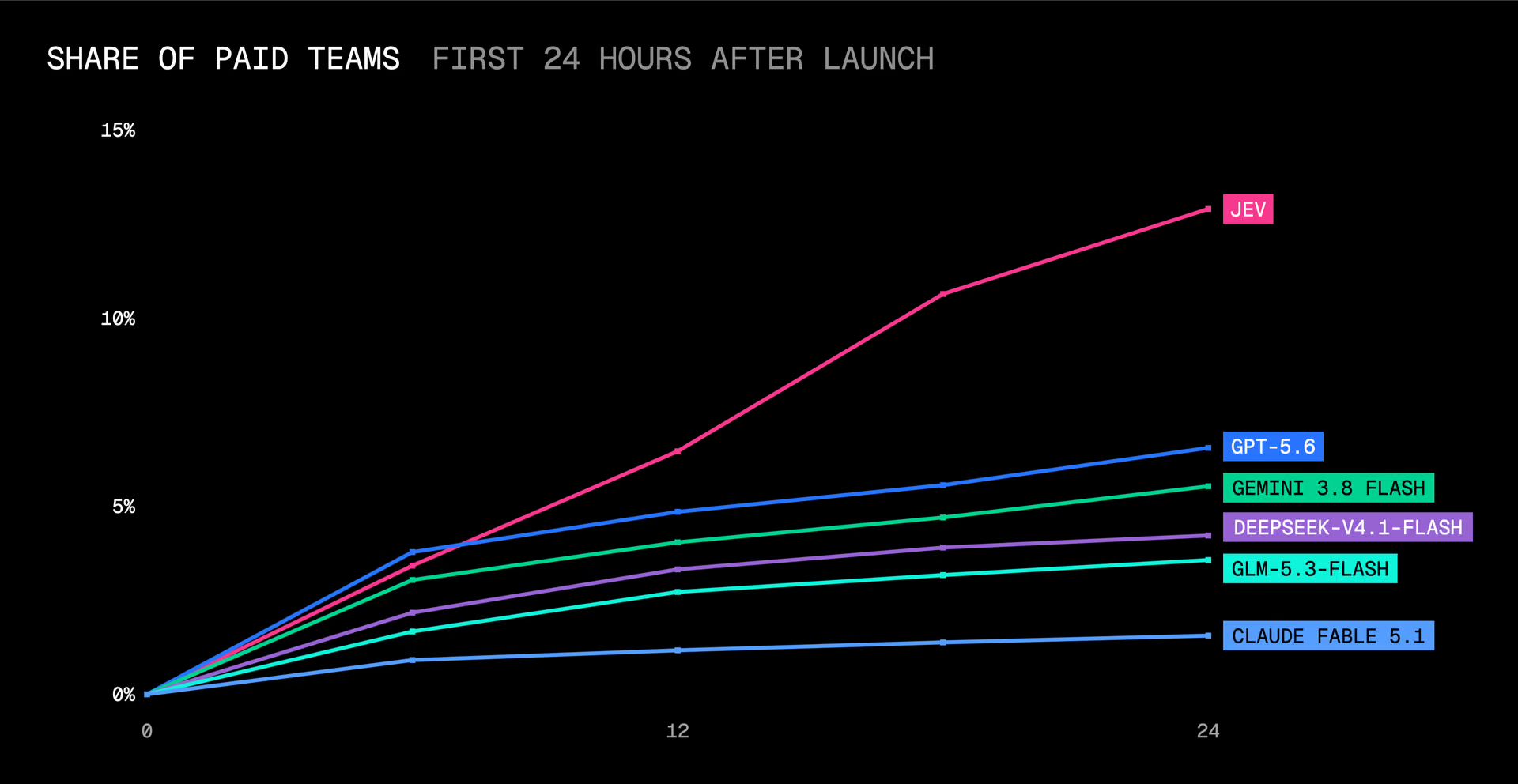
September 18: Vercel reported that nearly 13% of its paying teams had used Jev within 24 hours of its arrival on the platform.[8]
Image credit: Vercel, 2026-09-18. Official AI Gateway first-day adoption chart; unchanged apart from AVIF to PNG conversion.
Source: Vercel, September 18, 2026. The horizontal axis is hours since launch; the vertical axis is adoption among paying teams on that platform. It is neither a global developer share nor a task success rate.
This is a meaningful signal of developers' willingness to try the product. It does not yet establish how long they will keep using it or which tasks will improve.
TypeSafe lists input pricing at US$0.042 per million tokens, with no separate output charge.[11] Tokens are the units a model uses to process text, rather than a one-to-one count of words. The company reports end-to-end response times of 70–500 milliseconds, though individual requests vary.[1]
The widely repeated claims of roughly 194 times faster and 445 times cheaper come from TypeSafe's own workflow evaluation. The company says those gains may be toward the high end of real-world benefits. The comparison also used average predictions from other strong models as a reference, rather than checking every task against observed business outcomes.[1]
A more useful question for an adopter is what happens to accuracy, human review volume and total waiting time in its own ticket workflow. A cheaper call that creates more rework may not reduce the cost of the job.
“Zero hallucinations” does not mean “never chooses incorrectly”
Return to the retailer. If the allowed outputs are shipping, refunds and product questions, Jev will not invent a fourth department. That can eliminate a frustrating category of integration errors.
It can still select refunds when the customer is asking about delivery. The answer is valid; the decision is wrong.
TypeSafe's known-limitations documentation is candid about Jev 1.13: arithmetic, date comparisons and multi-step reasoning can be difficult. Excess irrelevant context can reduce accuracy, and misleading inputs can affect the answer.[9]
The way a question is written, the completeness of its options and the response to failure therefore remain essential parts of the system.
Jev also provides probabilities and confidence to help manage uncertainty. Confidence can be understood as how concentrated an answer is: when several options are close, more caution may be appropriate. It is not a guarantee of accuracy in every business setting. Thresholds need validation on the user's own data.[10]
Misfiling an email can be reversed. Approving a refund involves amounts, permissions and checks. Those actions should not receive identical authority just because a model reports the same confidence value.
Reliable automation requires both a model that can make judgments and software that knows when not to act on them.
From following instructions to finding the right role
Seen along this timeline, Almeida's new direction is less surprising. In 2022, the challenge was to make models follow human intent. Function calling and structured output then made responses easier to connect to programs. Jev focuses on frequent, narrow decisions with a defined range of answers.
My view is that its most interesting test is whether this division of labor works in real operations: general-purpose models where writing or deeper reasoning is needed, specialized models for fast judgments, and code for work that can be computed deterministically.
If it succeeds, the user may never encounter a more eloquent chatbot. They may simply find that a complaint reaches the right person promptly, the order has already been checked, uncertain cases go to a human, and they no longer have to explain the same problem to three support agents.
For AI inside software, that would be a worthwhile improvement.
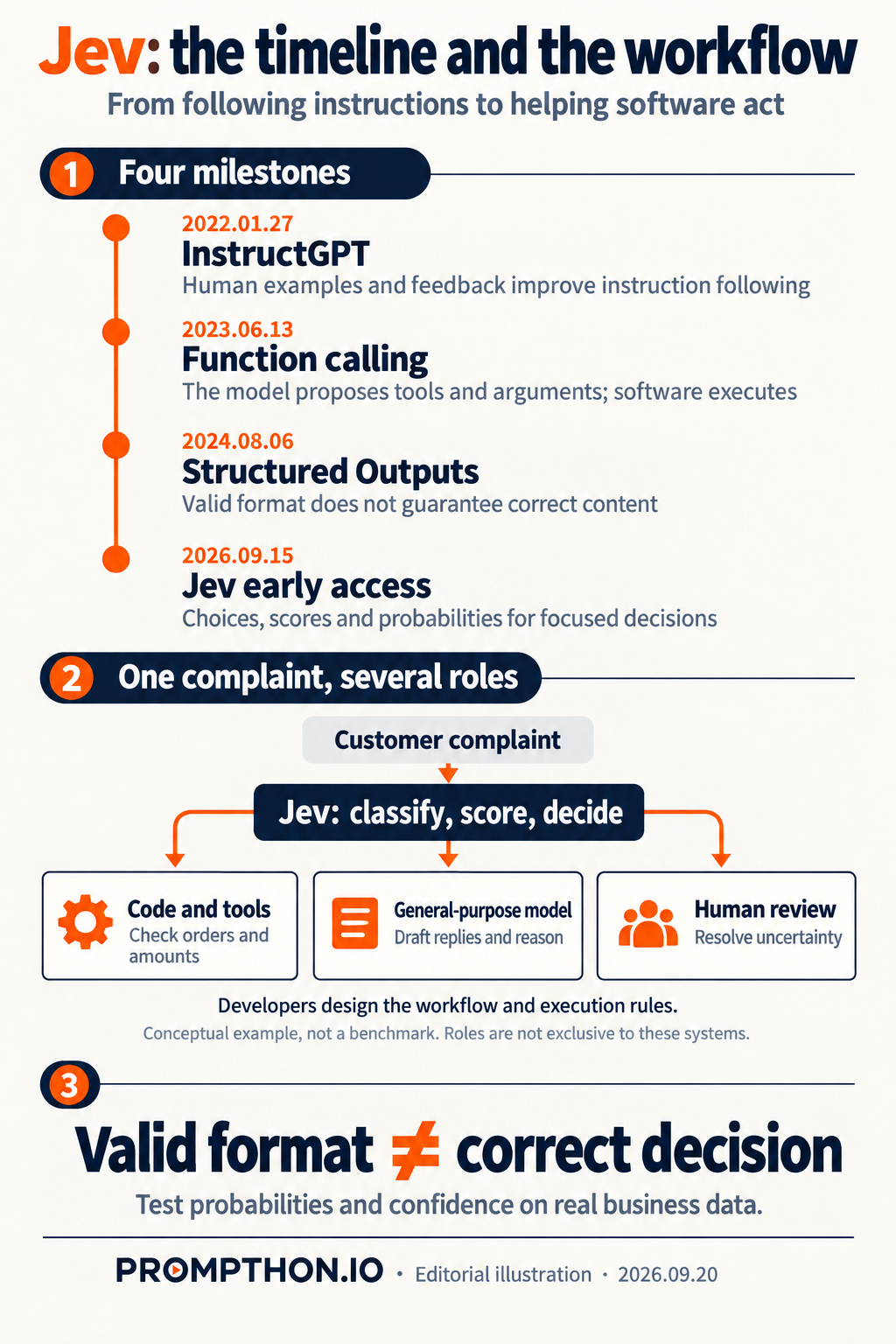
Jev in one picture
Image credit: Prompthon. GPT-localized editorial illustration; not factual photographic evidence.
GPT-generated Prompthon editorial illustration, based on the sources below. Dates refer to the relevant announcements; the support workflow is a conceptual example.
Sources
Prepared from public material available as of September 20, 2026. Performance figures are vendor or platform disclosures; Prompthon has not independently benchmarked Jev.